Showing posts with label AG1162A. Show all posts

Tuesday, 18 March 2014

First Motion-Applied-to-Concept-Art Test + Audio.

For the past few days I've been working on a large environment piece for our prototype idea. Rob and I met up on Sunday and had a little work jam, which turned out to be a great idea, because he managed to get a bunch of gesture tests working, and I managed to get the majority of this painting finished:


I'm really happy with how it turned out because it conveys a lot of the core aspects of our games' environment. Aside from the general mood and colours of the environment you can also get an idea of the navigation of the game, and also the hotspots which will be in the environment.

The clouds of smoke idea was inspired by many things for navigation, such as the mountain in Journey, and the desire to not have any HUD system or traditional guiding elements.

And I'm sure I've talked about the hot spots before but to re-iterate, they are the locations around the map which will trigger the stories and songs of the appalachian people and will be the areas in which the player can interact with objects.

To return to my part of the project specifically, I promised to use audio and motion to give a stronger sense of the game mechanics and aesthetics within my concept art. I've applied these to this piece of concept art and I'm really happy with the end result. The motion gives a greater sense of depth, which ultimately gives a much greater impression of how it would feel to explore in a 3D space. The audio also helps this along a ton. Good ol' freesounds.

Here's the motion concept art - make sure HD is on :


Also here's some style tests and cabin designs I did too.


Monday, 10 March 2014

Complementing Projects

There's been some big developments in the scope of this project since my last post, to say the least.

The new plans have all been green lit though, so that's the main thing.

The new project is a collaboration between Rob and myself. Rob's project is interested in evaluating and studying the emotive connotations of hand gestures in interactive environments. And my project is interested in conveying game mechanics/dynamics/aesthetics through concept art which have been developed through study of a specific story.

Rob's project, in his words, lacked a rich context which would support his experiments; and my project lacks the production side past 2D concept art, and also would be benefitted greatly through the use of gestures, which allow a more aesthetically pleasing and interactively strong way to explore.

The context of my projects' art was to be a folk tale, but I as looked into it, the way of the Appalachian people was much more interesting in its natural heritage and nuances than the stories themselves, at least in terms of explorational potential, I felt. The folk tales of Appalachia all stem from their way of life, and are all interwoven into their environment in some way or another. So, in theory, the Appalachian hillside could act like a hub for many folk stories, which would organically be portrayed to the player, preferably avoiding the interactive design misfire - literalism.

Rob and I are currently fleshing out the Aesthetics of our game as we are interested in the MDA approach to game design.

To give Rob something to work with while I developed some more concept art, I put together two mood boards: one to detail the environment mood, and another in attempt to capture the desired aesthetic gesture relationships I think would be great to experiment the value of the game with.

Environment

Gesture Aesthetics
For tomorrows' pitch group, we had set out a to-do list that we decided would be needed to give a clear picture of what it was we wanted to do, without having to give a long-winded explanation - an elevator pitch, basically.

I've currently written a good few pages of a GDD/Project guide for us, which we'll hopefully have fleshed out a bit more by the end of the week. I'll also have a few pieces of concept art to display (below), and Rob will probably have some gestural examples, which I'm really looking forward to seeing.


Sunday, 2 March 2014

Ramblings; On Inspiration; Her

It's important, as someone who works on games, to take inspiration from other media. As it stands, the emotional spectrum of games is expanding wonderfully, but the intricacies of the human condition aren't really all there yet, or at least as well as they are in, say, films or prose (Chen 2012). The emotional maturity of other media can be hugely uplifting for someone working on new games, because of the dull clichés and tropes which are rampant in games.

Her (2014)
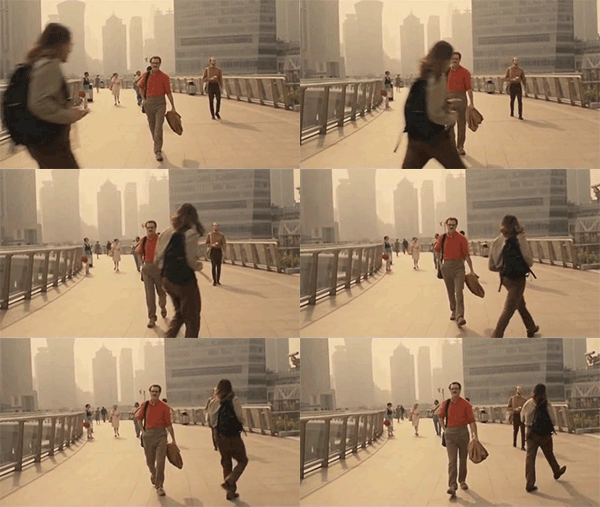
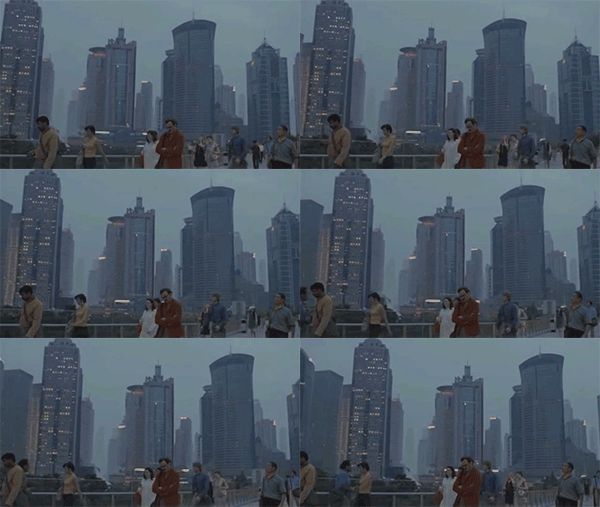
Her is a great example of a unique, true vision being realised. I had been looking forward to it for a long time, and although I saw it over a fortnight ago, it's still very much in my thoughts. The film is special in countless ways, and even if you cast the story aside, the visual design of the film is enough to make you stop and think. 

Note: There's an incredible article focused on the colour of Her. Like the film, the writing is very expressive and visceral, and the style really helps put across the dreamy personality of the film. 

Her (2014)
I don't want to go too much into the film in the form of synopsis (that article I linked does so extremely well) instead, I just want to talk about the moods in the film, and the way it uses colour, and why I think it matters for the work I'm doing.

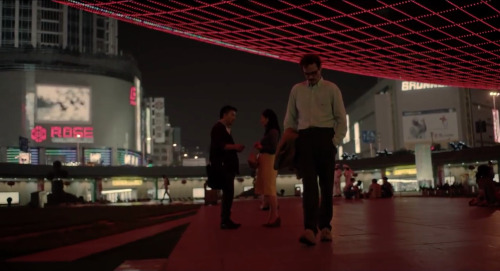
The western connotations of the colour red are generally well known: anxiety, danger, yada yada. Basic colour theory. But, in Her it takes on a new form; it's reborn. In a lot of the interviews and articles addressing this idea, the phrase "womb-like" seems to be the favourite attempt to verbalise the effects.

Her (2014)
Most of the interviews with the director tend to underplay the theory, shy away from the scrutiny, and basically put the whole thing down as an arbitrary creative expression. At least that's what I've taken away. And I sort of like that. Why do creative endeavours need to be contrived and thus over-analysed? Apparently, Spike Jonze, the director, is a big fan of napping, and really, even that's just enough for me to get the gist of where he was creatively when he was envisioning the aesthetics of the film.

I'm digressing slightly, but it's such a refreshing thought that I had to go off on a tangent there.

As I mentioned before, to me the red hues in Her didn't spell danger. Rather, it felt safe. And in a film which centers around isolation and loneliness, strangely it gave it a real personality - a pulse. And this feels familiar, it made what was on screen feel all the more real. And this idea starts to become really cool when you remember the plot of the film.

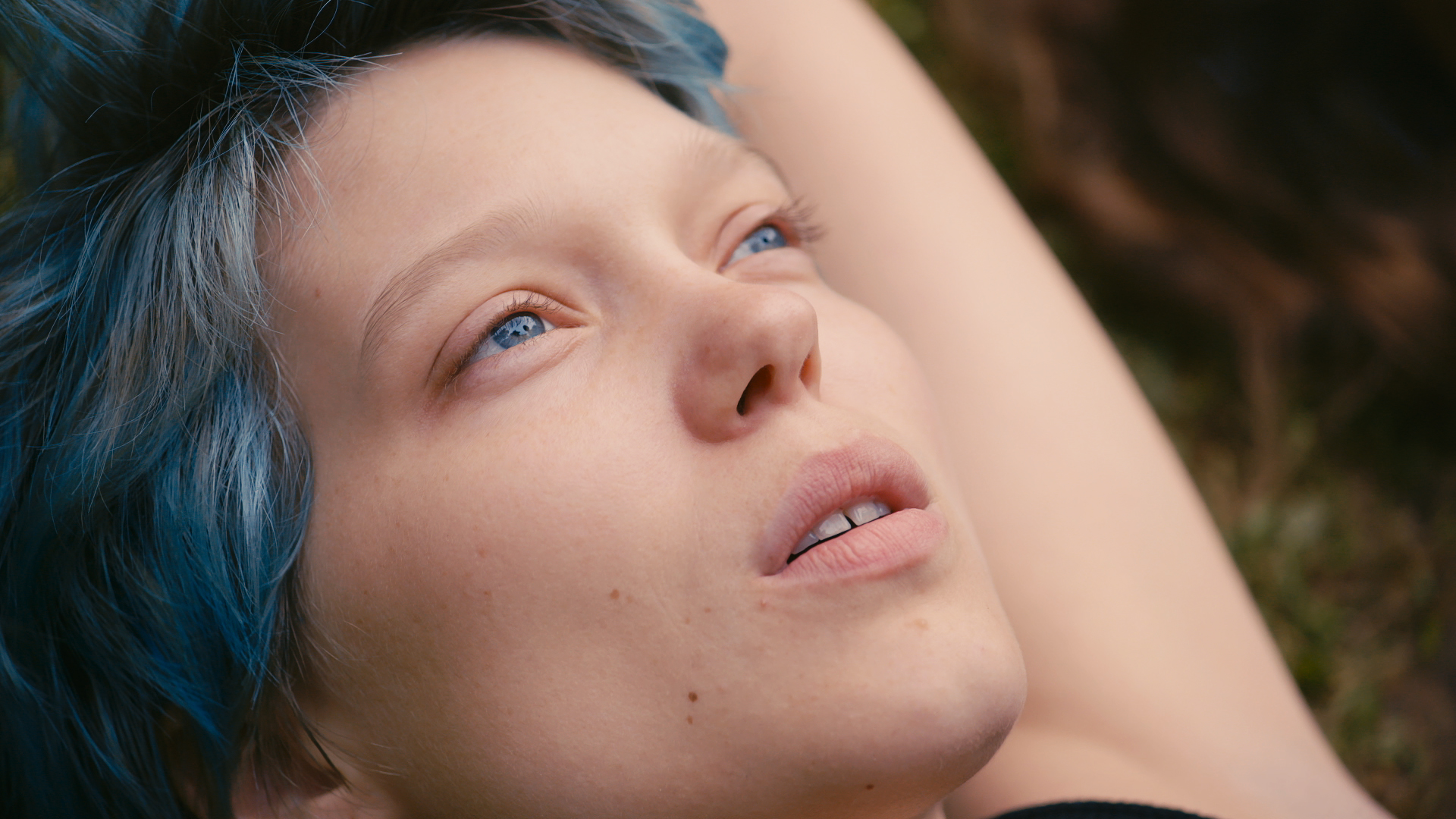
Blue is the Warmest Colour is another film which came out recently where the colour complemented the development of the plot really well, and like Her, it just added a ton to the lasting nature of the story. It's not something that I feel has directly influenced my work yet, but it's a task I set myself for this module to explore.


I'm going to keep these thoughts in mind while working on things for this project, and see if I can work out some sort of theme to go with my game idea. Still working on that part.

Kudos if you made it to the end of this brain vomit.

Friday, 21 February 2014

Step On it 2.0

Having just come back from a meeting with Dayna, I now have a firm plan of action for the project.

The blur of thoughts which existed, regarding what made this project a Masters project, rather than a clone of my honours project, is now clear.

To summarise, this project will aim to take the essence of a story, and develop the story into game ideas, which are analysed through the MDA process, and produce a library of art which showcases this game. The art will not be simply a line up of characters or environments; rather, clear visualisations of the game which convey the aesthetic and interactive value of the game.

Key Tasks.

- Have an elevator pitch for my game for the sessions next week. (Game setting, taken from a story, the type of game, the genre constrain, which games' theory inspire it, etc.

-This of course means having a game setting established or at least noted. Dayna suggested the idea of looking at Eric Zimmermans' stuff on brainstorming to help establish a root/base framework for working my game idea, so it's looking like a fair amount of game design theory will play a part in this. I'll also try and get some opinions from industry to help with general direction.

Another idea we spoke about was the tactile method of designing for games. Games like Tearaway and Tengami convey the benefits of this, and it should be interesting to perhaps set up some scenes in craft (although not inherently paper craft, because Tearaway's already nailed that) and polish them p in photoshop.

And then as I said, add some audio and motion to them to bring them to life a bit, and emphasise the game qualities through the concept art, and not just show a pretty picture.

Really looking forward to this now.


Step on it.

I sit here, it's the end of week 5, and I've yet to make any significant progress in this module since my proposal. 

This is bad. 

I mean, I've done a few sketches, but nothing which supports the train of thought which fueled my proposition. 

Although I'm hesitant, I think it's perhaps crucial that I dive in, or else it's going to be too late. I think I should kick things of with a case study, and create a link to my proposal. I need to choose an interesting game, in which I recognise the hero's journey, take screenshots at the key points, as identified in the theory, and create a ton of new artwork. The case study should help me create some sort of loose framework, if nothing else. I'm also going to take the artwork straight into Maya/AE to add some motion and audio, and then I might have something of value. 

Till then,

Wednesday, 5 February 2014

Spyro Re-work.

I had a quick meeting with Dayna last week, in which we went over my Research Proposal, the value of my project, and the timeless pop sensation that is - Phil Collins.

What we decided was that I needed to give myself a goal to work towards as soon as possible, or else the project might fall behind. So I decided to do a game-revamp, mainly to gear myself towards games, and better understand the designs behind them. 

I decided the Spyro franchise would be a good one to toy with. These are just very quick sketches, and so far I've just been trying to take the protagonist in different directions by messing around with proportions and such, and still trying to maintain that "Spyro" feel. 

More on this to come. 


Friday, 10 January 2014

Updated Aim & Objectives.

Since my Research Proposal is drawing to a close now, I figured I'd throw my refined Aim & Objectives up here. With added Bonus Research Question! +++

Research Question

Can art be used to more effectively complement traditional story arcs found in games, and does this practice lend itself to the interactive intent?

Aim

With the recognition of traditional story elements in contemporary games, the aim of this research project is to further understand the relationship with art and this traditional model of storytelling, and ultimately scrutinize and demonstrate the subjective effects which it can bestow upon the aesthetics, and interactive nature of games.


Objectives

Following an analysis of relevant literature, case studies, and methodologies behind the visuals of narrative-centric games, the study hopes to establish a detailed critical framework which aligns with the monomyth.

- The framework should serve the practice-based research of the project and allow for broad, intelligent designs to be contemplated and further developed.

- The project will then address the further implications of the visual arrivals, in the form of analysis and comparison specifically to the context of an interactive game environment.

- Ultimately, the project hopes to deliver an accomplished visual personality which plays to the traditional storytelling model, and is potentially relevant to engaging gameplay.


So, as you can see, in the past week or so the project has evolved enormously. Basically I realised that because traditional story patterns like the monomyth are present in seminal artistic games, I could use this as a parallel to creating my own artwork by using the pattern in my framework, and my analysis. 


Friday, 3 January 2014

Guests, Proposal, and other thoughts.

Before I get into the real topic however, I just realised I never put my preliminary Aim and Objectives on here. I decided these in week 9 (the week of my presentation), and they are as follows:

Aim

To visually experiment and understand the different ways in which literature can act as a malleable and beneficial tool for developing interesting conceptual artwork and development intended for interactive media.

Objectives

1. Create an array of visual style tests supported by relevant literature to scrutinise against a predetermined critical framework.

2. Research dynamic artwork techniques and speculate different methods of application

3. Demonstrate a collection of dynamic visual interpretations of literature with a strong consideration of their interactive possibilities and consider further implementations.

Now, on with the show -

Guests

Over the course of semester one there were several guest talks from a range of people with backgrounds in both academia and industry. The final talk of the semester was from The Story Mechanics founder and - go figure - story enthusiast, Simon Meek.

 In his talk Simon covered a lot of ground. From his own beginnings as a civil engineering and journalism, to Dimmer - a revered short story by author Joy Williams, to Rosencrantz and Guildenstern Are Dead.

Unfortunately, Simon was unable to stick around for a chat afterwards, but nonetheless, his talk was extremely helpful in providing me a truckload of food for thought for my research proposal.

The talk was basically a crash course/101 in narrative design, and the scope of the narrative designer was quite the eye opener.

Proposal

I'm still whittling the old argument for this. I'm definitely getting there, but time is running out. This happened in honours too. I had to be separated, take some distance, from my Proposal, which was wayyy off the map, to see how misguided I was.

Nonetheless, I'm positive that because of this awareness, I'll avoid some of naive mistakes a bit better. I've found quite a number of good sources, and it's been interesting to see the range of points I've stumbled across in terms of year and location.

The main struggle has been the balance of research to interaction, and art work. As I said, I spent my honours working on illustrative styles, and visual development, so I've written a ton on that. But, that's sorta' what this project was to be heavy on - Art. But then the art needs to backed up with reading, and I'm sorta going back on myself.

A lot of this might not be making too much sense. But hey, blogging thoughts as the pop up can be good for making me say or realise what I might not be able to by being precious about my posts. So I'll stick with it for now.

Other Thoughts

I purchased "Gone Home" today, but haven't had the chance to play it properly yet. Because of the relatively opposing opinions on cinematics and story in games, I think it should make for a great case study, and if not, a ton of fun and hopefully inspirational.

Finally, although the nature of this module sort of suggests the practical work begin in the second semester, I've done some sketches anyway.


Light Tests (Photoshop)
I didn't use any reference photographs for any of the lighting in these tests, and so I'm real happy with how they turned out. For me adding in the light helps the characterisation by adding context. I feel this is best illustrated through the bottom left sketch and the sitting down woman and the woman wearing the mac on the right.
Sketch (iPad) Paint Over (Photoshop)
 This was a first for me. I often sketch on my iPad (about as much as traditionally), and it's great. But this is the first time I've liked a sketch enough to want to paint it. This was a fairly quick exercise, and you can see the majority of colour is just thrown on, especially for the dungarees dude.

Walden/Misc Sketches (Photoshop).
I did these way back in week 7 or 8. I was thinking about designing an avatar for Henry D. Thoreau in Walden; or Life in the Woods. And when I was doing the original sketches I began to wonder how the skeletal structure of these characters would look, and maybe my sketches would be better if I got some not-realistic, but at least believable skull anatomy to build on. It sort of helped, but it meant I was real restricted when it came to shape and proportion.

Monday, 25 November 2013

On Gamification

Naturally, I've given a great deal of thought to the importance of potential gameplay within this project.

Last week I completed an informal case study which I made to compare the ways in which digital adaptations can be handled, and to hopefully better understand where they shine or perhaps fail to shine, and more importantly why.

The two adaptations I chose were The Story Mechanics' steam-available The 39 Steps, and EA's Alice: Madness Returns

The 39 Steps

It's seems to me that TSM are possibly testing the water with The 39 Steps. This adaptation is all about the original story. It is very much interactive, and there are gameplay elements scattered throughout, but ultimately there's a lot of respect paid to the original text. 

The 39 Steps is a digital story adaptation by The Story Mechanics

And that's cool. I like the idea of giving these classics a new filter. Especially if the artwork is strong and plays to the charms of the original prose.

 The artwork here really seals in the changing moods of the different acts and lends the whole experience a sort of torch lit under-the-bed covers reading atmosphere. That's the best way I can think to describe it. If you can't relate to that, well, your childhood sucked. 

Motion Graphics. 

I think I mentioned motion graphics in a previous post. Either way, I mentioned them in my presentation last week (which went fine) and how they're something that I didn't experiment with enough during honours, and as they work so effectively in The 39 Steps, would like to properly try out this year. 

Art Style(s).

This is something that I really didn't see coming. About 2-3 scenes in, there is a flashback/anecdote in the story. At this point the art style completely changes to a very simple, silhouette-based style. 


The way the shift in style plays to the literary technique here is very effective. It keeps the story fresh and emphasizes the flashback nicely. This is something that's been done in movies (and games) many times. I love the use of style shift here. 

Roles. 


The way this adaptation assigns itself is something to be noted also. In it, the player controls the narration, and other areas such as letters, locked doors, etc., and the characters' monologue and dialogue are subtitles at the bottom of the screen.

Alice: Madness Returns

Alice is an adaptation in the traditional sense of the word. I guess you could say The 39 Steps is a direct adaptation to a visual-interactive form. Alice takes the original story of Alice's Adventures in Wonderland, and molds it to suit a desired audience and transports it into a fully realised game narrative and world. 

Alice: Madness Returns

Art Style.

(Aesthetically) The characters in The 39 Steps are (arguably) no more realised or fleshed out than the novel. And this is of course intended and relevant to what they wanted to achieve. I'm not trying to judge anything. I'm merely noting everything for my own practice. 

In Alice, the creators obviously wanted to create a solid 3D world and art-style synonymous with Madness Returns. The finished art style is very stylised and strongly expresses the psychological horror nature of the game. 

Concept Illustration - Joy Ang
In Game
Roles.

Nothing special here, you play as Alice throughout the entire game (as far as I'm aware). I still have to play the game. But from the articles I've read, the Art of book, and play-through videos, it would appear this is the case. 


I can illustrate a point; We have the technology.
Moving swiftly on

Gamification.

...Is totally a word - and a great word at that. 

I stumbled across this video this morning - and it sent me on a tangent. I've not really gotten all that far with the thought yet, but bear with me. 

In the video, Chris speaks about the need for gamification in certain games. At one point he mentions Super Mario 64, and explains that players often had the most fun just running around the colourful environment as Mario in 3D. 


The nostalgia is tangible with this one.
The way the game felt and played to your senses was enough. By taking simple elements we are all familiar with and juicing them in certain ways, the player could enjoy themselves. No score/points. Just inherent pleasure within the way the game felt. 


Sand. Fun for the whole family.
Just like the way Journey takes advantage of the players' imagination with sand. In Journey you slide elegantly down the sand dunes as you cross them. This isn't what happens in reality. But if you asked eight year old you what should happen, it would probably be a safe bet to assume something along the lines of the above. (Somewhat paraphrased from a Jenova Chen presentation)

Basically all I'm getting at with this is that because it's easy to take an idea, run it through a gamification machine and hey presto! you have a game, I want to take elements from the story which would sing through clever gameplay. Don't just go for the obvious in adaptation for interactivity. Films certainly don't; rather, play to the stengths and tease these everyday things like playing in the sand and let your imagination run wild.

Bye for now, 

Monday, 4 November 2013

The First Meeting with Dayna and Co.

Meeting

At the end of last week myself, Mus, Kayleigh and Sam all met up with Dayna to have a chat about the Interactive Classics project. 

The meeting was really interesting and I think it would be nice if we met like this regularly. This was suggested during the meeting, so it looks like that will probably be the case. 

Dayna was switched on to the project idea after reading a book by French renaissance writer, Francoise Rabelais. The book was Gargantua, and is a fine example of 16th century satire. One of the sections in the book describes the protagonists' plight to find the perfect item to wipe his butt with - and this was the section Dayna favoured most:

I have', answered Gargantua, 'by a long and curious experience found out a means to wipe my bum. The most lordly, the most excellent, the most convenient that was ever seen. I have wiped my tail with a hen, with a cock, with a pullet, with a calf's skin, with a hare, with a pigeon, with a cormorant, with an attorney's bag, with a Montero, with a falconer's lure. But to conclude, I say and maintain that of all the torcheculs, arsewisps, bumfodders, tail-napkins, bunghole cleansers, and wipe-breeches, there is none in the world comparable to the neck of a goose, that is well downed, if you hold her head betwixt your legs. And believe me therein upon mine honour, for you will thereby feel in your nockhole a most wonderful pleasure, both in regard of the softness of the said down and of the temporate heat of the goose, which is easily communicated to the bum-gut and the rest of the inwards, in so far as to come even to the regions of the heart and brains.

The Story Mechanics

I've signed up to the next Story Mechanics lab session. I'm really looking forward to this because I haven't really got any idea what it'll be like. The session is titled "The Protagonist", and is going to be held near the end of this month, but the date is yet to be confirmed.

Personal Thoughts

I previously expressed an interest to focus on the interactive side of the adaptation process; but I didn't really have any real thoughts on what I wanted to achieve.

During the meeting I began to think about the way "O' Brother, Where Art Thou" was created. I love the indirect idea of adaptation, and the way in which the story is taken and applied in a completely different context. So sort of using the original stories' events as a vague guide to tell your own story.

That lead me on to thinking about folk tales and the way in which they were spread because of the important strong life lessons they preached. And then I started to think about how interactive story telling could harness these lessons. So say if I was to take something like the original tale of Cinderella from the Grimm collection (which differs greatly from the Disney adaptation, and can be read here), or at least the purpose/lesson from it, and weaved it into a new context, in which you make the decisions. Basically a half breed between an adaptation and a Choose your Own Adventure! book. I think this idea is still pretty crummy, but I normally need to go through a bunch of these ideas before the good ones start arriving. So I'm not too worried as I have an avenue to start looking into at least.

That's all folks.

Thursday, 24 October 2013

Innovation and Professional Development.

So we're now almost at the point in this module where I can now make (hopefully) informed and (hopefully) interesting blog posts.

So as I'm sure I mentioned in a previous post, this module is basically an honours project in itself.

However, unlike the honours project, we were given the option to choose a research topic from a list devised, and I think influenced by the respective tutors' area of research. The option was still there to devise your own project of course. However, some of the pre-determined project questions really stood out to me and so I e-mailed Dayna straight away to try and justify my place on the projects - which you can see below.

---------------------------------------------

1st Choice: Interactive Classics: Adapting Old Texts for New Audiences and Platforms. 

As visual development for story adaptation was my honours project I was naturally excited by this one as it remains an area of great interest to me. My previous study established a framework of design theory within adaptation and used this as a catalyst for my own adaptation artwork. I've also followed the work of The Story Mechanics for some time now and am very interested in the work they do. 

In this project I would be able to provide a strong understanding of design methodologies specifically for story adaptations and of course a great deal of enthusiasm to expand my critical and reflective approach, especially to better understand the interactive potential of adaptation. 

2nd Choice: Exploring the use of abstract visuals and audio to drive the design of game mechanics within an experimental computer game.

This just sounds so awesome. Abstraction in imagery is something that has always fascinated me. And the idea of exploring abstraction interpolated between visuals and game mechanics just sounds like something I could get on board with. I'm unsure if my skills are as suited to the brief as others may be, but in terms of personal interest I think I would be a good fit and could adapt well. 

3rd Choice: Strangers in a Game.

Like many people I'm a huge fan of Journey and the way in which it handled the spontaneous interaction of genuine strangers. I would love the chance to explore the workings of this idea in greater depths. I think the psychology and existing games related to this area would be an excellent means of rapid development for innovative ideas.  

---------------------------------------------

As I mentioned in the E-mail, I already have a backbone of research in terms of aesthetics and composition theory in visual development specifically for story. However, the interactive side of things was something I payed relatively little attention to. Stepping into this brief excites me because it could potentially result in me having this body of work, relative to an area I would like to work in, with which I could demonstrate and expose to potential employers.

Having had a quick chat with Ryan, who will also hopefully be involved in the project, it looks as though the concept art output would be extremely heavy, which works for me. I think working with others will be a nice change of pace, as the solitary research nature of the honours project can become disheartening and ambiguous in, well, all manners. Of course I don't mean that to sound as negative as it perhaps did (as I loved the honours project), but the thought of having regular contact with someone working in the exact same context I imagine will be so much more exciting and will undoubtedly result in questions, approaches, and discussions I, otherwise, might not have had.

I also loved Lynn's project as abstraction is something which fascinates me. However, I knew I wasn't the best suited for the project and so that, and my third choice, was more of a risk.

However, I've been assigned to the digital adaptation one so I'm looking forward to starting that. Two other students have also been assigned to this task, so it should be interesting to watch  the different ways our research paths develop.

Dayna mentioned there would be potential to go along to one of The Story Mechanics story labs. The labs are something I've checked on frequently. The next lab is in November and it's focusing on "The Protagonist", which sounds like it should be really cool. So hopefully we can all go along to that and get the ball rolling.


Followers