Thursday, 24 October 2013

Innovation and Professional Development.

So we're now almost at the point in this module where I can now make (hopefully) informed and (hopefully) interesting blog posts.

So as I'm sure I mentioned in a previous post, this module is basically an honours project in itself.

However, unlike the honours project, we were given the option to choose a research topic from a list devised, and I think influenced by the respective tutors' area of research. The option was still there to devise your own project of course. However, some of the pre-determined project questions really stood out to me and so I e-mailed Dayna straight away to try and justify my place on the projects - which you can see below.

---------------------------------------------

1st Choice: Interactive Classics: Adapting Old Texts for New Audiences and Platforms. 

As visual development for story adaptation was my honours project I was naturally excited by this one as it remains an area of great interest to me. My previous study established a framework of design theory within adaptation and used this as a catalyst for my own adaptation artwork. I've also followed the work of The Story Mechanics for some time now and am very interested in the work they do. 

In this project I would be able to provide a strong understanding of design methodologies specifically for story adaptations and of course a great deal of enthusiasm to expand my critical and reflective approach, especially to better understand the interactive potential of adaptation. 

2nd Choice: Exploring the use of abstract visuals and audio to drive the design of game mechanics within an experimental computer game.

This just sounds so awesome. Abstraction in imagery is something that has always fascinated me. And the idea of exploring abstraction interpolated between visuals and game mechanics just sounds like something I could get on board with. I'm unsure if my skills are as suited to the brief as others may be, but in terms of personal interest I think I would be a good fit and could adapt well. 

3rd Choice: Strangers in a Game.

Like many people I'm a huge fan of Journey and the way in which it handled the spontaneous interaction of genuine strangers. I would love the chance to explore the workings of this idea in greater depths. I think the psychology and existing games related to this area would be an excellent means of rapid development for innovative ideas.  

---------------------------------------------

As I mentioned in the E-mail, I already have a backbone of research in terms of aesthetics and composition theory in visual development specifically for story. However, the interactive side of things was something I payed relatively little attention to. Stepping into this brief excites me because it could potentially result in me having this body of work, relative to an area I would like to work in, with which I could demonstrate and expose to potential employers.

Having had a quick chat with Ryan, who will also hopefully be involved in the project, it looks as though the concept art output would be extremely heavy, which works for me. I think working with others will be a nice change of pace, as the solitary research nature of the honours project can become disheartening and ambiguous in, well, all manners. Of course I don't mean that to sound as negative as it perhaps did (as I loved the honours project), but the thought of having regular contact with someone working in the exact same context I imagine will be so much more exciting and will undoubtedly result in questions, approaches, and discussions I, otherwise, might not have had.

I also loved Lynn's project as abstraction is something which fascinates me. However, I knew I wasn't the best suited for the project and so that, and my third choice, was more of a risk.

However, I've been assigned to the digital adaptation one so I'm looking forward to starting that. Two other students have also been assigned to this task, so it should be interesting to watch  the different ways our research paths develop.

Dayna mentioned there would be potential to go along to one of The Story Mechanics story labs. The labs are something I've checked on frequently. The next lab is in November and it's focusing on "The Protagonist", which sounds like it should be really cool. So hopefully we can all go along to that and get the ball rolling.


Monday, 21 October 2013

Animation: consuming all my time since this morning.

I've animated the first couple of seconds of my 11 Second Club entry. This scene has taken me a number of hours to animate, and it still only has a block as the second character. Because the scene is very close to the face of the Male character, it was crucial that he didn't look rigid or lifeless. Currently, by industry standards, it still falls short. However, I feel it's heading in the right direction.


Thanks,

Tuesday, 15 October 2013

Getting back into Animation.

The animation I did over the Summer for Dare to be Digital was farely minimal, and not particularly well executed. The last time I really spent any real time on 3D animation was in third year and I loved it for the most part. Maya, right?

I was disappointed in myself for not completing the optional task of creating a dance animation the other week. I did actually start one, and it was going well, but I got side-tracked on other modules, and never managed to finish anything.

So today I've spent some time creating a walk cycle in Maya using the 11 Rig. My 11 second club plan doesn't include a walk cycle, but I figured I should practice a bit before diving straight into my animation.

The 11 Rig is awesome, and so I've had a great time just focusing on animation principles, without having to worry about my lackluster Maya prowess.

Here's what I've managed to get in the last few hours.


So now I'm going to block out my ESC animation, and should have more to report on that later in the week.

Thanks,

Wednesday, 9 October 2013

Low Poly Modelling and Textures.

Low Poly Modelling and Textures is a module which places interest in the appropriate topology for specific 3D model applications.

For the module we've to create low, and high polygon models for a character, a vehicle, and an environment.

The first step of this project was to complete a Personal Development Plan (PDP).

So this is what I wrote up last week, and is in no way final:

Student Name: Rory Jobson

Core Discipline: Character Art for Games and Animation.

Area of Enquiry: Stylised conceptual artwork and an efficient transition into 3D assets for games.

Agreed Action points:

General.
- Module Blog
- Life Drawing Classes each week. (Subject to demand)
- 2-3 Digital tutors videos per week.
- Study of relevant industry professionals for each area of development and where applicable/available study the pipeline from 2D - 3D art.

Design and a contextual relation.

Character: Experimenting with pose and proportion. (Digital Sketchbook)
Vehicle: Experiment using existing methodologies. Focus on theory behind (Mechanisms).
Environment: Ongoing study of architecture and nature and how they correlate.

Agreed Deliverables:

Appropriate Visual Development (in the form of a digital sketchbook) for the creation of 3D character, vehicle, and environment assets for both low poly and high poly projects. Digital sketchbook should include the understanding and exploring of necessary topology.

All maya files for 3D models created and their corresponding texturing, mapping and rendering files.

Blog in the form of a .PDF.

I should hopefully have some artwork ready to show by the end of the week.

Cheers

Tuesday, 8 October 2013

3D Character Animation.

The version of this module that I completed back in the third year of my undergrad was the module that really got me working hard and making great work. And someone once said you only make great work when you're doing work you enjoy. So I guess you could say I'm excited about this module.

Ok, perhaps the work I did in third year wasn't exactly great; but it was a module in which I feel I progressed the most, and without which I might have been less devoted to my work present day. 

The module has come a long way since then which is very exciting. And it I think this new setup of dailies and external competitions will be an even greater vehicle for the students of the class to hone their skills. 

 For the coursework, the Computer Arts students can choose to create an animation(s) for narrative purposes, VFX demonstration, or Games. 

Because I'm doing Games Development we've been asked to focus on creating a polished showreel of animation for games. 

However, before we dive into the coursework I'll explain the external competition I mentioned previously. 


So we're all making submissions for the 11 second club. Awesome. 

The clip for this years participants goes like this: 

Voice One: "Oh, no, everything's fine."
Voice Two: "But the animal is inside out. And it exploded."
Voice One: "Hold please."

Originally, I figured the clip would be more ambiguous than this. It seems strange that a competition which receives so many applications would use such a specific audio clip. Then again, maybe it's a good thing; maybe it helps animators to become more creative in their search for story. 

My Interpretation. 

So initially the audio clip made me picture some guy, who's animal has just exploded, on the phone to some disillusioned customer services worker.

So I went away and did some sketches to get the ball rolling. I know these character development sheets are in no way required seeing as I'll be using an existing character rig, but they're good for moulding and brainstorming your characters personality. And they make good portfolio pieces. 


However, after some more thinking I started to picture something of a buddy-movie theme in the clip. Almost like a sort of Kick-Ass & Hit Girl relationship.

Characters:

Blue Jasmine (Superheroin) (Voice One)
Hal - (Teenager) (Voice Two)
Monster.

Premise:

After winning a competition, local teenager has the chance to see his favourite superhero(in) - Blue Jasmine - in action. However, she is not as excited about this opportunity as he is.

Beats:

1. Camera is focused towards a terrified Hal, hiding behind a rock.
2. Blue Jasmine lands next to him. "Oh, no, everything's fine."
3. While Hal says "But the Animal is inside out." Blue Jasmine does some stretches, completely care-free and ready for the challenge.
4. Explosion sound is heard. Debris flies across the screen and past the characters. We see Hal duck and hide behind the rock. Blue Jasmine appears completely nonchalant to the explosion and catches a piece of the Animal which hurtles towards her.
5. Blue Jasmine hands Hal the object: "Hold please". Then leaps off screen to fight. Hal and the Creature look on in Awe.

Storyboards:


So the plan for the next post for this module will hopefully have the basic animation blocked out.

Cheers


Friday, 4 October 2013

The Computer Game Development Project and Keeping it Simple.

The Computer Game Development Project is the heavyweight module of the Games Development Course. Spanning three semesters it consists of two University briefs, and ultimately, one professional client brief.

The module is not so much interested in your area of discipline, per se; rather the accuracy and focus in which you pertain to the exact overall design aim of the group, and the avoidance of personal work/style habits which may not serve to benefit the clients' wishes.

 So far we've been placed into groups and assigned desks.

The brief for this semester is to create a game inspired by the following:

Impact

A New Day

The Few

We had an excellent brainstorming session yesterday morning in which we watched a ton of gameplay videos of recent games we each admired and that consisted of innovative mechanics and distinct art styles.

Naturally, because the game is to be completely by January, keeping things simple and straight-forward is crucial.

A game I suggested for inspiration which I felt captured this essence were:

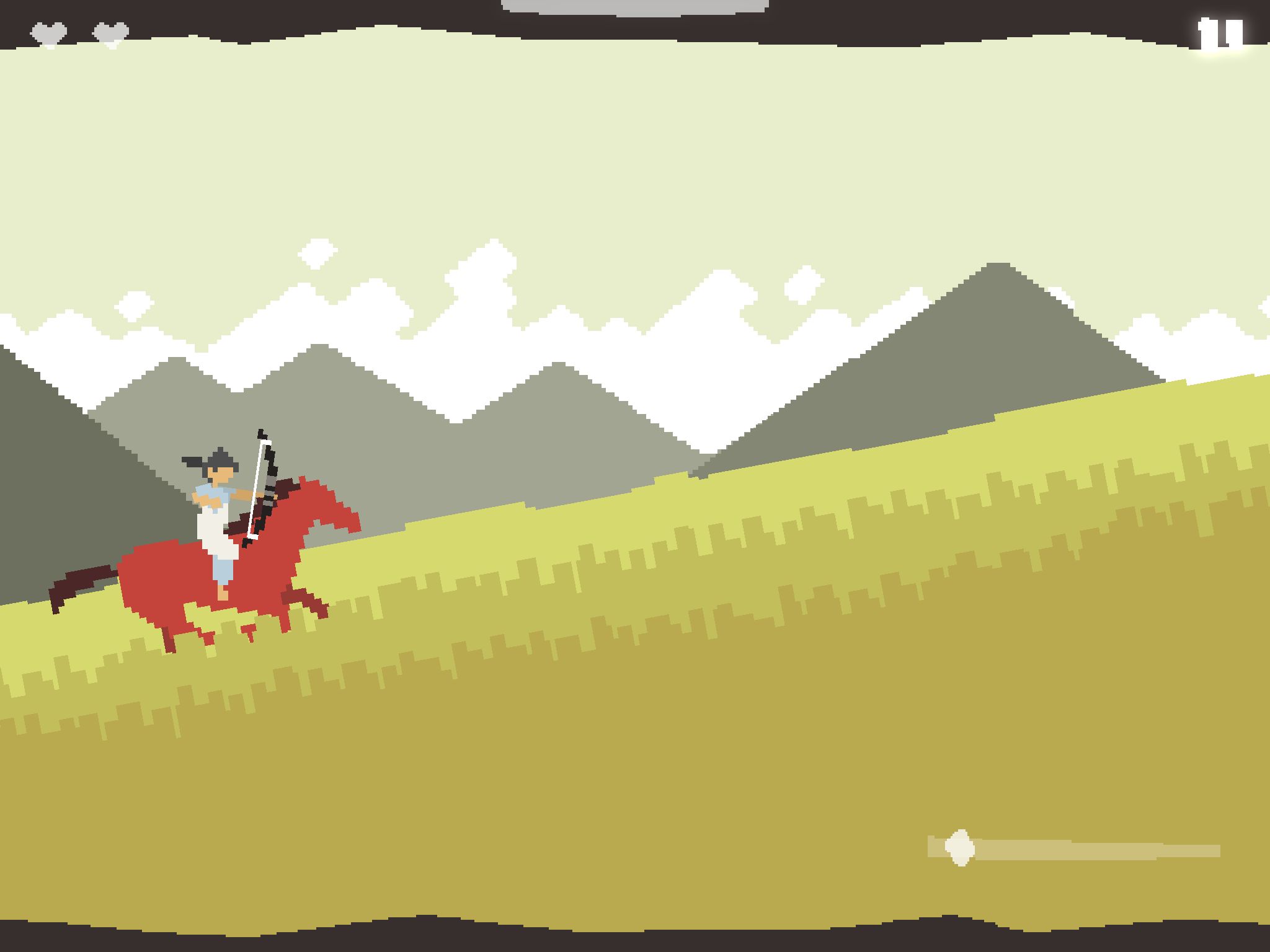
A Ride Into The Mountains. - Chia-Yu Chen and Lee-Kuo Chen

the beautifully fresh and tranquil visuals of ARITM go over great on tablet.
A Ride Into The Mountains is one of my favourite short games. As a demonstration of what can be done in mobile games in regards to keeping things simple, while demonstrating a high standard of "fun" it succeeds, for me, in many aspects. 

The Game

So in ARITM you play as Zu as you travel through a cleverly rendered pixel-art world on his trusty (seemingly rotoscoped) horse. The fact that this is one of my favourite mobile games says a a lot about the gameplay and visual design because normally pixel art games, on a purely aesthetic level, do not grab my attention, and sort of get "thrown in the pile".

The game begins in the woods and as you would imagine ends in the mountains. Throughout the game you experience a full day cycle and as such this allows the game a great sense of scale and adventure. The night-time scenes especially, harness a very fresh colour palette, which translates very confidently into the pixel art. Unlike many pixel-art games which, in terms of artistic style, can come across very poorly due to a poor understanding of colour theory and pixel-art fundamentals.

The gameplay revolves the usual "angry birds" slingshot mechanic (and this does feel great on the iPad's large screen). However, where the game comes into its own is through its added dynamics of this mechanic, and others.

To start off with, almost the entire game is a frantic gallop, and as such grants it a very urgent, immediate feel. Which is awesome because this gives the player a strong sense of purpose. You don't get the chance to put it down. The player can also tilt the device to speed up and slow down.  As the enemies circle around the player this becomes an exciting addition to the game play and also a nice balancing act of dodging and striking.

The Art

Colour, Scale, 

Colour (and mood) plays a strong role in this game and at times reminds me of the critically applauded "Swords & Sworcery". As I touched on before, the desaturated colours emphasise the grandeur and importance of the games narrative. This is no place for primary colours in this game. Except for the bright red horse of course, which acts as a great contrast to the environment throughout.

Game Ideas. 

So the game idea was a fusion between my own idea, and the idea of our programmer.

So because we only have a few weeks to not just create this game, but hopefully apply some level of polish, we took a very a "Less is more" approach to both the game design and proposed art style.

Basically we all admired the cleanliness of games like ARITM, and in turn wanted our game to also have a sophisticated, fresh feel to it.

The gameplay transpires from the Rube Goldberg idea of cause and effect mechanisms. The games' character will move independently and it will be up to the player to alter the Goldberg influenced environment to correctly guide the character to the end of the levels.

Their is only one "character" in the game at the moment.

-The Moon.

At the beginning of the levels you see the moon resting in the sky. The player witnesses the Moon fall from the sky into the level - and the game begins.

The goal is to clear a path to allow the moon to roll effortlessly through the level and rise as the sun upon completion. 

As for the length of the levels, that remains to be decided. And our designer is currently working on creating interesting level structures.

There are a few artistic methodologies/theories that I would like to consider for the art creation and level design of the game.

The first one stems from a diagram in Chris Solarski's book "Video Game Art and Drawing Fundamentals", which notes the idea of harmony and dissonance in video games.


“Soft, rounded shapes are the obvious choice for designing an environment of natural, organic beauty. But you need an element against which to measure this beauty”

I feel this could benefit our levels as our character is simply... a circle. And it would quickly become obvious the sense of dissonance if our environment began to evolve as the levels progess.

So for the past few days I've been experimenting with visuals styles and shapes to try and find a nice environment for our games' context.

Early Visual Development

So aside from the moon, everything else is purely for test purposes - nothing close to finished.

Also the "Move" is just a working title I came up with. More on that later.

I think that should do it for now,
more to come soon.


Monday, 30 September 2013

Masters of Professional Practice in Games Development.


And so it begins.

what was previously my Honours project blog is now transforming to become my (MProf) Games Development research blog. So here we go.

For this semester only my Modules are as follows:

Low Polygon Modelling and Textures ( AG1141A) - Ken Fee
3D Character Animation (AG1141A) - Lynn Parker
The Games Marketplace (AG1160A) - Iain Donald

Also,

Innovation and Professional Development (AG1162A) - Dayna Galloway
Computer Game Development Project (AG1165A) - Ken Fee & Grant Clarke

Which are both double-semester modules.

End of Week one. 

As this is the end of week one, I've had an introduction to all of the modules, and have been assigned some small tasks in a couple of them to have ready for the next class and been informed of the coursework.

Module Summary.

Low Polygon Modelling and Textures ( AG1141A)

This module places focus on the importance of relevant topological requirements in games. The modules' coursework consists of creating 3D models of a character, vehicle, and environment or prop. However, we are required to create versions of the models appropriate for both games and animation/films. So a low poly model and a high poly model with suitable topology.

Image available at Arlab.com


3D Character Animation (AG1141A)

we get to make a 3D animation ! More on this to come in a later post.

The Games Marketplace (AG1160A)

For Iain's module there will be an open book exam - my first in 4 years. And we were asked to consider the following queries by examining relevant current texts.

Questions/topics:
- How have games impacted culture (and vice versa)?
- List some seminal games and examine how they have impacted society.

Innovation and Professional Development (AG1162A) - Double-Semester Module. 

Dayna's module, as the name states, is interested in an individuals furthering of their professional thinking and practice. Much like the my undergraduate Honours Project, it appears a lot of time will be spent reading relevant literature and reflecting, and subsequent experimentation in a field I have identified in my Project Proposal. The proposal is due in January and is the only piece of required coursework for this semester and should be no less than 3000 words and be supported by a strong review of literature.

From my Undergraduate Honours Project.


Computer Game Development Project (AG1165A) - Double-Semester Module

-New blog post to follow focused on this module.


Followers